
I was first introduced to beet kvass when I visited Bulgaria years ago. It’s a strangely salty drink that might not be for everyone, but if you like it, this recipe is an easy way to make homemade beet kvass without whey!
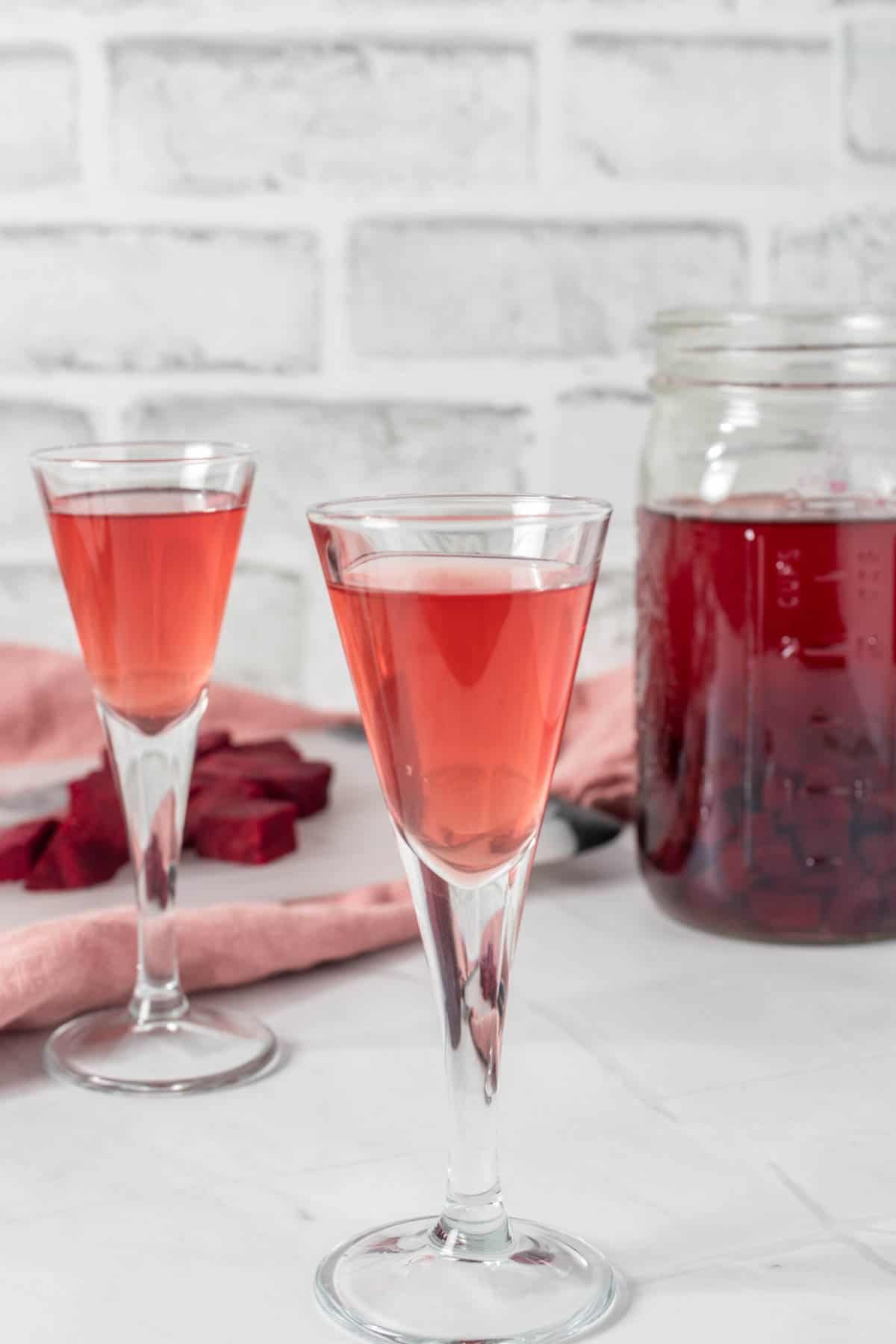
This post contains helpful tips and tricks! If you’re in a rush, please use the “Jump to Recipe” above!
🥃 What is Beet Kvass?
Beet kvass is an Eastern European probiotic drink with fermented beets. It’s sweet, salty and tastes like beet juice / kombucha! As the beet kvass ferments, it obtains a vibrant pink-red color thanks to the pigments released by the beets. The same fermentation process is also responsible for converting this into a probiotic tonic.
💭 Why you’ll love this recipe
- Great for digestion. Beet kvass promotes intestinal health. Some folks drink it as a tonic or you can cook with it like vinegar.
- Simple recipe, 10 minutes of active prep time. This is a great recipe for folks who like salty-sour things like pickle juice or sauerkraut liquid.
- Use up a ton of beets. If you’re bored of roasting beets (like this roasted beet salad) this is a great way to use up your beet harvest this year.
📋 Ingredients and notes
You’ll need just three ingredients for this recipe: beets, filtered water, and sea salt (not table salt!) You can also add lemon or ginger to change up the flavor of the kvass if you like.
Notes and Variations
- Use sea salt (or kosher salt). You’ll need to use salt that is free of iodine and/or anti-caking agents – these typically work against fermentation. Today, I’ve used Himalayan pink salt (also an unrefined type of salt).
- Bacterial cultures to speed up the process. If you have pickle juice (from live cultures found in a refrigerated section of your grocery store) you can also add those to speed up the process.
- Use non-chlorinated water. Chlorinated water inhibits fermentation, so use distilled or filtered water to make sure the recipe works!
- Spices and flavors. I love adding ginger and lemon to my beet kvass since they add a nice citrusy-burst to the earthy flavors. You can also add garlic, rosemary and other pickling herbs (e.g., dill)
📖 Step-by-step instructions
Beet kvass is quite simple to make, so I’ve described the key “active” steps below. Much of it is just waiting for the fermentation fairies to do their job after!
- Peel and dice four organic beets (I prefer buying these organic). Then, place them in a sterile half gallon jar. Roughly 24 oz of beets.
- Boil 6 cups of filtered water with 1.5 tablespoons of sea salt or in my case, Himalayan pink salt and then allow it to completely cool down.
- Pour into jar, leaving an inch of headroom (allows fermentation gases to accumulate, or else the pressure will pop the lid off once you let it cool!)
- Cover with a lid but don’t screw it on too tight. Place in a tray of sorts to collect drips and place in a cool dark place.
- After 5 to 7 days, you should see some slight bubbling. Once you see bubbling, tighten the lid. Then, open and close the lid once or twice a day for about 3 to 4 days. This lets the trapped gases escape.
- Strain the liquid after that, or leave the beets in and then pop them in the fridge to consume over the next week or two.
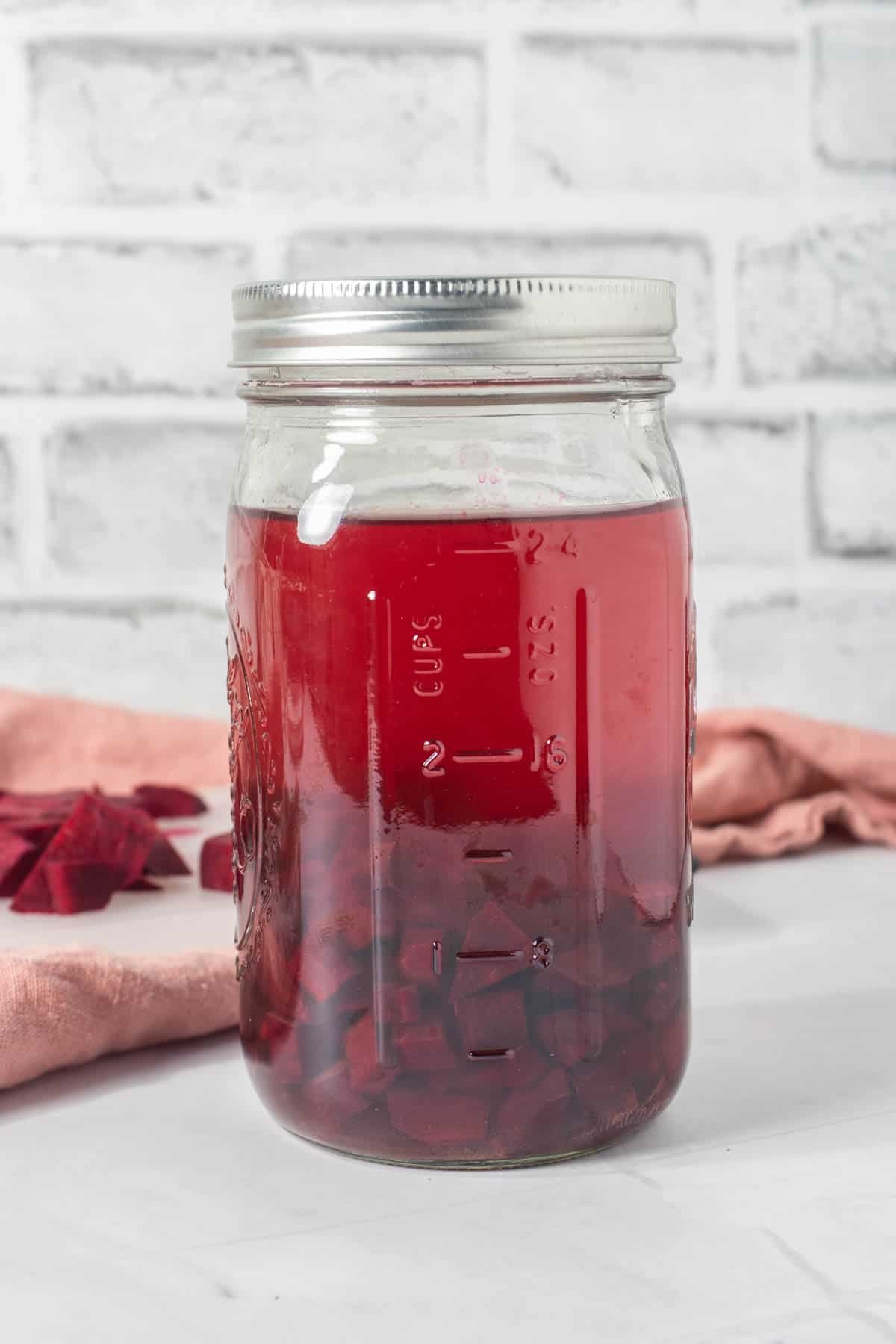
White foam at the top is typically pretty harmless, so you can just skim it right off when you see it (but if you see blue moldy substances, you’ll need to discard your kvass and start again).
If you plan to make more kvass, remember to save a bit of the brine in the jar with the beets. This can be used as a culture for the next batch.
👩🏽🍳Top tips and FAQs
When the liquid has drained, it’s safe to eat the beets! I typically like to save them for a second batch of kvass, but you can also throw them in a salad. If you do reuse for a second batch, I recommend composting the beets after use.
It is a healthy probiotic tonic – beets are very nutritious (rich in folate, manganese, copper, potassium, antioxidants and anti-inflammatory compounds) and kvass adds a probiotic twist to it.
I typically suggest fermenting the kvass for at least 5 to 7 days. Ideally, the taste is most magnified when you let it go on for 2 weeks. However, there’s no hard and fast rule – the taste gets stronger the longer you let it ferment!
Ha, great question. Kvass is usually less than 2% of alcohol by volume and typically considered a nonalcoholic beverage!
It’s an acquired taste, that’s for sure. I typically like adding a bit of ginger and lemon or other pickling spices to add complementary flavors. Some people also add cabbage and apple to the kvass fermentation to dilute the flavors a bit more!
I admit – they’re really similar drinks, in flavor and function. However, the key difference is that kombucha relies on symbiotic culture of bacteria and yeast (SCOBY) to ferment while kvass uses a process called lacto-fermentation due to natural sugars in the beets.
🍴 Serving and storage suggestions
I like to let my kvass ferment for 7 to 10 days before drinking but you could drink it straight away. I like to add a shot glass worth of it to my morning or nightly routine. You can also dilute it and drink it as a tonic but drinking too much might cause bloating and nausea, so start small!
Beet kvass can be stored in the fridge for up to 2 weeks after you’re done fermenting it. It does tend to get stronger the longer it sits in the fridge (though fermentation slows down considerably due to the temperature).
If you like this recipe, check out these other fun recipes:
[fsri image_class=”feast-image-round” id=”2018,2475,5502,5513″]
If you tried this recipe, don’t forget to comment and rate! ⭐⭐⭐⭐⭐

Beet Kvass
Ingredients
- 4 beets, organic, peeled
- 2 tablespoons Himalayan pink salt, can substitute with sea salt
- 6 cups filtered water
Instructions
- Note: I strongly suggest wearing gloves while making this recipe to ensure that bacteria from your hands don't get into the fermentation process. Or wash your hands thoroughly!
- Rinse a half gallon jar with a close fitting lid thoroughly. Fill it with hot filtered water to rise, sterilize, and then set aside.
- Rinse your knife with hot boiling water. Cut off the greens and save them for other dishes. Rinse the beets thoroughly, peel them, and then slice them into small cubes. Place them into the jar.
- Add 2 tablespoons of Himalayan pink salt to 6 cups of filtered water in a saucepan. Bring to a boil to dissolve the salt completely and then let it cool down fully.
- Pour the water into the jar once cooled, and close loosely with a lid. Place the jar on a saucer or plate to catch drips and store in a cool and dark locations with minimal light for at least 7 to 10 days.
- Open the jar each day to check for any white yeast formation (and if so, skim it off and throw it away). Opening and closing the lid also allows for the gases to escape.
- After about 10 days, you can strain the liquid, close the lid more firmly, and put it in the fridge. The kvass will continue to ferment, but it will be slowed down significantly due to the temperature. Leftover beets can be used to make another round of kvass or used in a salad or thrown away.
- I typically dilute a shot glass portion of the kvass with some filtered water, add a squeeze of lemon and some ginger to drink it like a tonic!
Notes
- Please ensure that the jar and all utensils (e.g., knife, cutting board) you are using for kvass are disinfected with boiling water. This reduces the risk of introducing unwanted bacteria and will ensure that the fermentation can be achieved in the best way! I typically use disposable gloves and board to prepare the beets.
- Check on the kvass daily and remove any white layer formation with a wooden spatula or spoon.
- This is definitely a drink that’ll take some time getting used to! I typically do a shot glass of kvass (similar to what’s pictured in the post) and squeeze a tiny bit of lemon juice on top.
Nutrition
Nutrition information is automatically calculated, so should only be used as an approximation.


