
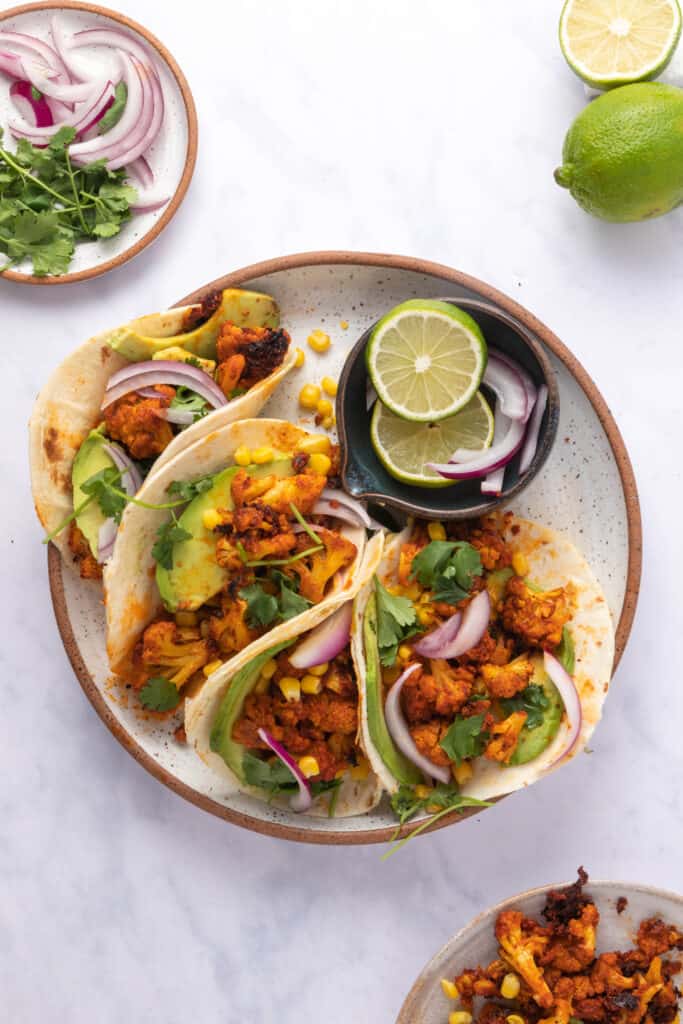
These delicious vegan gochujang cauliflower tacos with avocado, corn, red onions and cilantro. Perfect for an indulgent weeknight dinner or for a dinner party with friends.
This post contains helpful tips and tricks! If you’re in a rush, please use the “Jump to Recipe” above!
💭What makes this recipe work?
- Vegan taco filling, easily made gluten-free. The cauliflower filling used is super simple to make and packs a punch without any breading!
- Spicy but not too spicy: Gochujang has a sweet-spicy taste with a huge hit of umami
- Perfect make-ahead meal. You can roast a big batch of cauliflower florets or the whole cauliflower and use it through the week
- Easy to customize. Once you make the base cauliflower, it’s easy to customize other toppings to make several variations of this fun taco!
Oh, and if you’re interested in roasting the full cauliflower, check out my ultimate guide to making whole roasted cauliflower
📋 Ingredients
To make these cauliflower tacos – you’ll need cauliflower, Korean gochujang sauce, tahini paste, soy sauce, fresh lime juice, garlic powder, avocado oil, salt and pepper. Then, for taco toppings, I use avocado, cilantro, sweet corn, and red onions with lime juice.
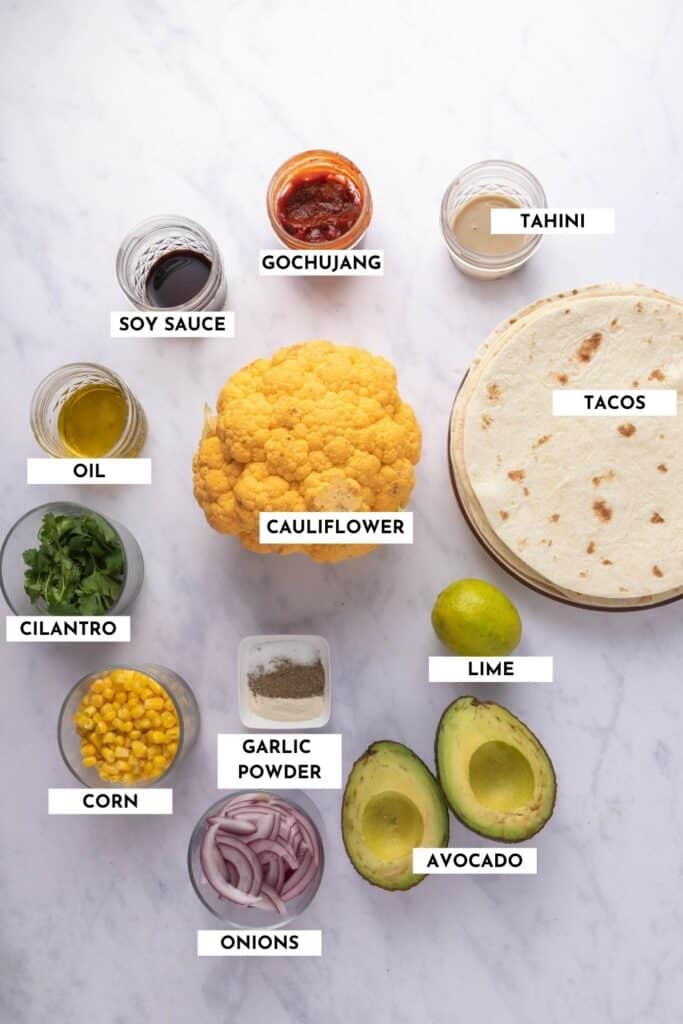
Ingredient notes – tips and swaps
- Use whole cauliflower or florets. There are detailed instructions on breaking down a cauliflower in the next section
- Use avocado oil or vegetable oil – not olive oil. You’ll be roasting the cauliflower as close to 500F as you can get. Olive oil has a much lower smoke point, so it doesn’t work for this recipe. I suggest using avocado oil or vegetable oil instead.
- Easy substitutions for gochujang paste. You can use Thai chili paste, a thicker hot sauce, or soak red pepper flakes in soy sauce and use that instead. Check the FAQs for a quick substitute you can make at home as well.
🌮 Making the cauliflower tacos
Break down the whole cauliflower (skip this step if using florets already)
This is done in four simple steps. First, you remove any large leaves from the base. Flip the cauliflower on it’s head on a cutting board or clean counter. Use a small paring knife to remove the core of the cauliflower. Then, break the cauliflower into large florets (I just use my hands for this step). Finally, use a knife to slice off the larger parts of the stem so you can get even florets (this is helpful for cooking them evenly).
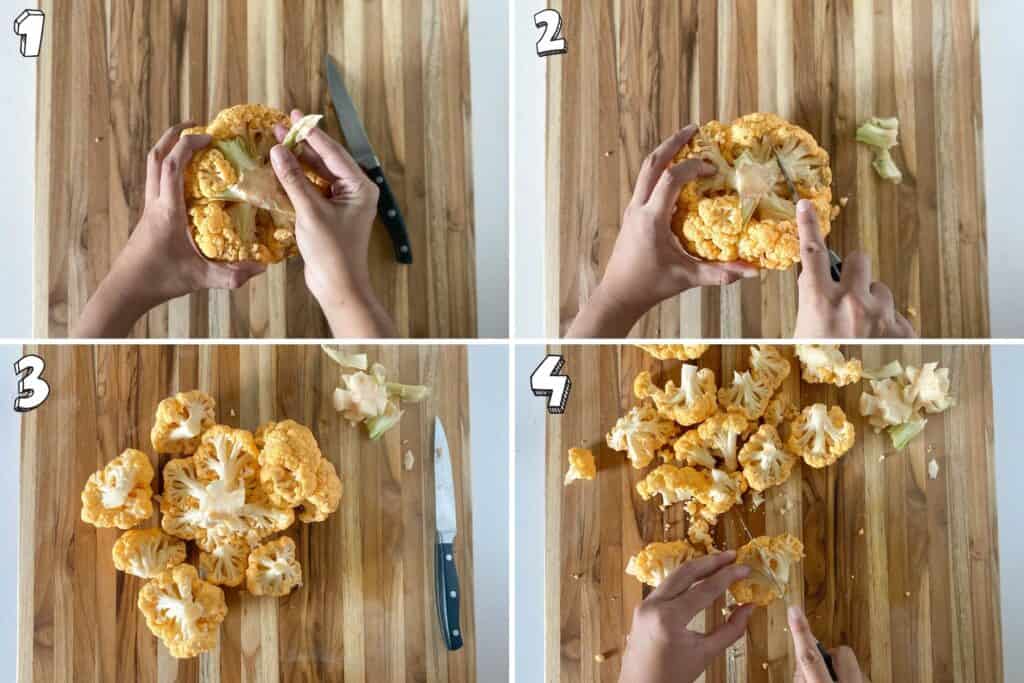
Make sure to get rid of any florets that have really dark spots on the surface, and collect the rest in a bowl for washing.

Wash and dry the florets thoroughly. Toss them with oil, salt and pepper in a mixing bowl. Spread them on a baking sheet, and pop in oven at 450 F for 15 minutes.
This helps to dry out florets and starts roasting process (so you don’t end up with a bunch of mushy florets).
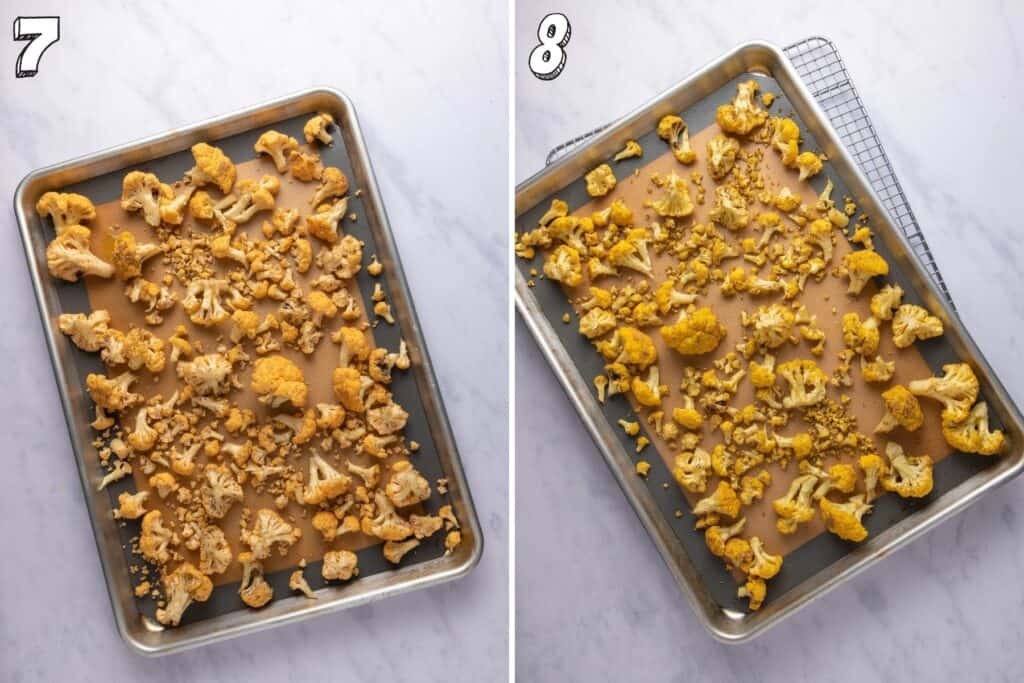
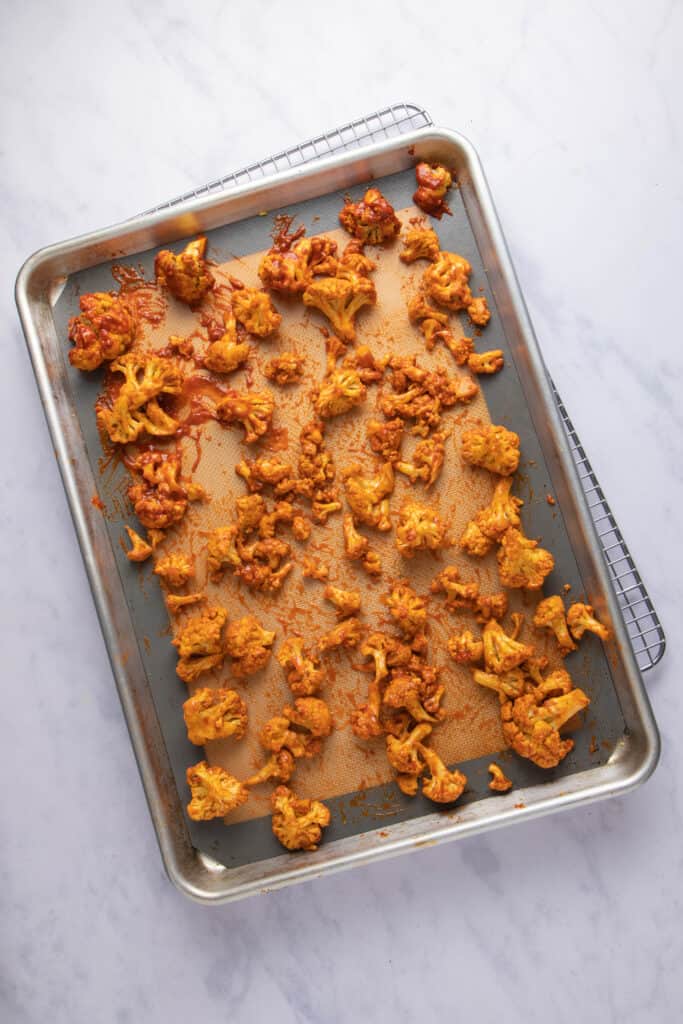
While the florets are roasting, make the gochujang-tahini cauliflower sauce. Toss the florets in this sauce and pop them back into the oven and bake for 20 minutes.
Mix gochujang sauce, tahini paste, oil, soy sauce, fresh lime juice, and of garlic powder until it forms a sauce-like consistency. In terms of spice tolerance, I recommend tasting the sauce as you’re making it to make sure it works for you. If you need to dilute, add oil or soy sauce based on your preference.
📖 Taco Variations
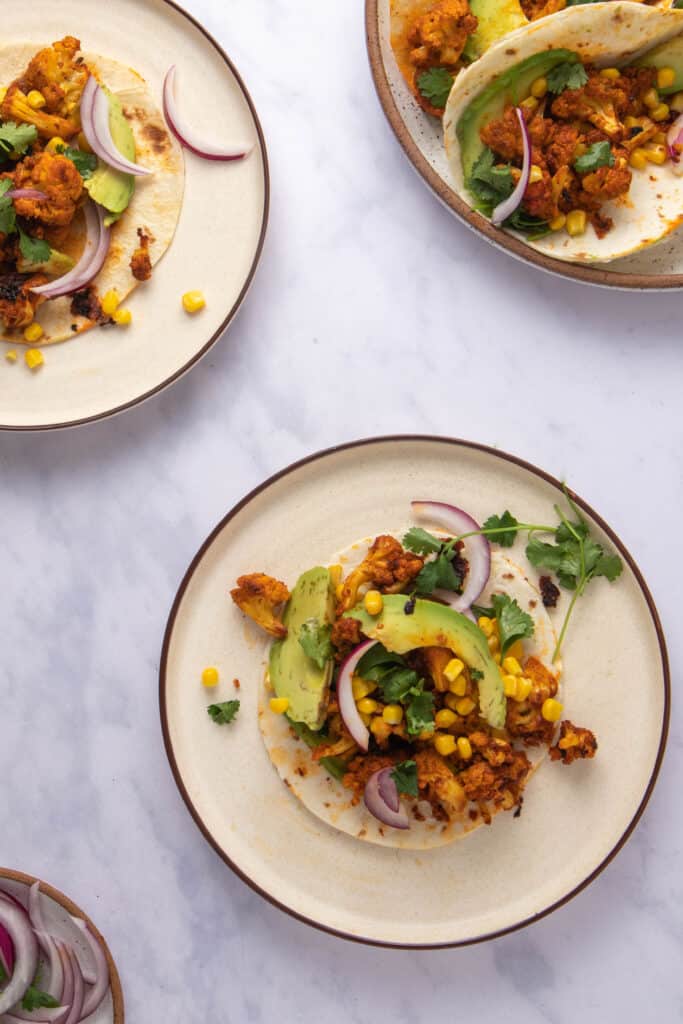
Once your taco base is ready, load up your taco with cauliflower, avocado, thinly sliced red onions, sweet corn (frozen or fresh) and finish with a squeeze of lime juice.
If you want to mix it up a bit, here are some potential variations:
- Make it gluten-free: Use gluten-free tacos or better yet, use lettuce cups. Make sure to use tamari in place of soy sauce if you’re gluten free as well.
- Convert it into a breakfast taco: Scramble up some eggs (or an egg-substitute like Just Egg) along with avocado, black beans and corn (and cheddar if you eat dairy).
- No taco? Make it a salad bowl. Add the cauliflower florets along with some red onions, corn, quinoa or rice, and black beans to a bowl with a drizzle of lime juice on top and make a hearty bowl out of it!
👩🏽🍳 FAQs and Tips
Gochujang is a vegan, Korean red chili paste that’s made with glutinous rice, fermented soy beans and salt. Despite it’s fiery red color, the flavor can range from sweet to spicy, making it the backbone of Korean cooking.
Yes, you can make a good approximation at home! Mix 1/4 cup each of water and brown sugar and bring it to a boil. Once the sugar is dissolved, add 1/4 cup of miso paste and stir until it makes a smooth paste. Then, add ~1/8 cup of red chili powder to this and continue stirring until dissolved fully. Take off the heat and let it cool to room temperature, add a splash of rice wine vinegar and store in the refrigerator!
There are two main reasons why roasted cauliflower turns soggy: overcrowding the pan, and using too much oil. The best way to avoid this is by using a large baking sheet where you can arrange the cauliflower in a single layer without crowding too much, and by watching the amount of oil you use in the recipe. I use about 1.5 tbsp of oil while first roasting the cauliflower and another 1 tbsp in the sauce to give it the right consistency!
If you tried this recipe, don’t forget to comment and rate! ⭐⭐⭐⭐⭐

Gochujang Cauliflower Tacos
Ingredients
Sauce Ingredients
- 3 tablespoons gochujang sauce, check notes for substitutions
- 1 tablespoon tahini paste
- 1 tablespoon soy sauce, use low sodium version, or substitute with tamari for gluten-free option
- 1 teaspoon garlic powder
- 1 teaspoon lime juice
- 1 tablespoon avocado oil, sub with vegetable oil if unavailable
- 1 tablespoon chickpea flour, (optional, but makes it even crispier)
Cauliflower Tacos
- 1 cauliflower, broken into florets (check instructions)
- 1 tablespoon avocado oil , sub with vegetable oil if unavailable
- 1½ teaspoons salt, adjust to taste
- 1 teaspoon black pepper, adjust to taste
- 2 avocados, sliced into small pieces
- ½ red onion, thinly sliced
- 3 sprigs cilantro, stems removed
- ½ lime, for juice
Instructions
Prepare and pre-roast the cauliflower florets
- Preheat the oven to 425°F
- Remove the large leaves of the cauliflower. Flip it upside down on its head on your cutting board or a clean counter. Use a paring knife to remove the base (core). Now, using your hands, break the cauliflower into large florets. Finally, use a knife to cut off the large stems to get even sized small florets for tacos.
- Wash and dry the florets thoroughly. Then, add them to a mixing bowl along with some avocado oil, salt, and pepper and toss to coat evenly.
- Line a large baking sheet with parchment paper and spread out the cauliflower florets so they're not overcrowding (use two baking sheets if necessary!) Roast for about 10-15 minutes while you prepare the sauce! When they're done baking, pat them dry with a paper towel.Note: Overcrowding and using too much oil are the two main reasons why roasted cauliflower ends up soggy. Avoid this by tossing florets in oil using a mixing bowl, and also by using a large-enough baking sheet so you can spread them in a single layer.
Prepare the sauce
- In the same mixing bowl as before, add the gochujang sauce, tahini paste, soy sauce, garlic powder, lime juice and avocado oil. Using a fork or a whisk, mix really well to aerate and combine into a sauce-like consistency.Note: If you're not using gochujang and instead using a hot sauce that's more fluid, reduce the amount of oil so you're still left with a nice sauce-like consistency.
Roast the cauliflower and assemble tacos!
- Remove the cauliflower from the oven, and crank it up as close to 500°F as your oven will allow. Then, using a slotted spoon or tongs, coat the florets in the gochujang sauce, taking care to drain the excess. I typically just pick up a few florets at a time, drop them in the mixing bowl and use a spoon to coat them. Make sure to shake off all the excess!
- Place them back on the baking sheet, nicely spread them out, one layer thick and pop them back in the oven for about 10 more minutes. You'll notice the edges start to brown nicely – that's a good sign that they're done cooking. If it's not done in 10 minutes, let it bake for another 2 to 3 minutes.
- While the cauliflower is baking, slice your avocados and red onions. If you're using corn on the cob, place them on a plate, cover with a paper towel and pop into the microwave for about 3 minutes. Warm up your soft tacos on the stove if you're using those.
- Once the cauliflower is done baking, remove carefully from the oven and place on a heat resistant surface. Add a few florets, along with the rest of the toppings, garnish with cilantro and a squeeze of lime and dig right in!
Notes
- Gochujang sauce is a Korean fermented spice paste that is now available in a lot of common grocery stores (as well as Asian specialty stores and Amazon, which I’ve linked in the recipe card above). If you can’t find gochujang sauce, you can use a thick hot sauce or Thai chili sauce in a pinch. I don’t recommend using Sriracha since the sauce is more watery, and has a strong garlic taste, which might counteract the tahini and soy flavors.
- This is a tastefully spicy dish – but you can increase or decrease the spice level to your tastes by adding more or less gochujang paste.
- This dish is vegan as presented and can be made gluten-free by making two substitutions – replace the soy sauce with tamari, and replace the tacos with a lettuce wrap or a gluten-free taco shell.
Nutrition
Nutrition information is automatically calculated, so should only be used as an approximation.
Note: This recipe was published on Feb 2, 2020 and updated on Sep 7, 2020 to include more detailed instructions and updated photos.
If you try this recipe, let me know! Leave a comment, rate it, and don’t forget to tag a photo #urbanfarmie on Instagram or @urbanfarmie on Pinterest!


These look delicious! When do you add the chickpea flour?
Thanks Kelly! If I use chickpea flour, I add it to the marinade – like, a couple of teaspoons, just to give it some body to crisp up! If you wish, you can also add breadcrumbs if you want to make it more crispy!
This looks awesome. Although I hate coriander I LOVE gochujang! Nice vegan recipe!
This was DELICIOUS!! I’m a gochujang neophyte and I absolutely loved the spicy, sweet, tangy flavor on the cauliflower. Thanks a ton for the totally idiot-proof instructions – so simple to follow, and we had an amazing meal ready in less than an hour. Keep em coming!!
Thanks, Dharini! Glad you enjoyed the tacos, stay tuned for more stuff! 🙂